Vox Machina

A USB Audio Engine for Android

Powerful · Elegant · Sacred

Vox Machina is a USB audio engine for listeners whose libraries are kept, not streamed. The Engine answers to one obligation: deliver your signal to your DAC intact, and prove it arrived intact. There is no listening to flatter, no behavior to study, no taste to predict. There is the signal, the wire, and the witness. Nothing is added. Nothing is taken.

The Forge has taken care that the depth of the Engine never demands labor of the listener. Every surface has been made considered, every mechanism sanctified, every reach effortless. The power is not hidden — it is simply ready when the listener arrives.

For listeners who would forge their own path, the Engine offers more chambers still — equalizer, convolver, crossfeed, four resampler filter philosophies. Each is the listener's hand on the signal. Every alteration is named. The Engine never bends your music. It hands you the means, and witnesses what you do.

Get it on Google Play

Paid once. No subscription. No further toll.

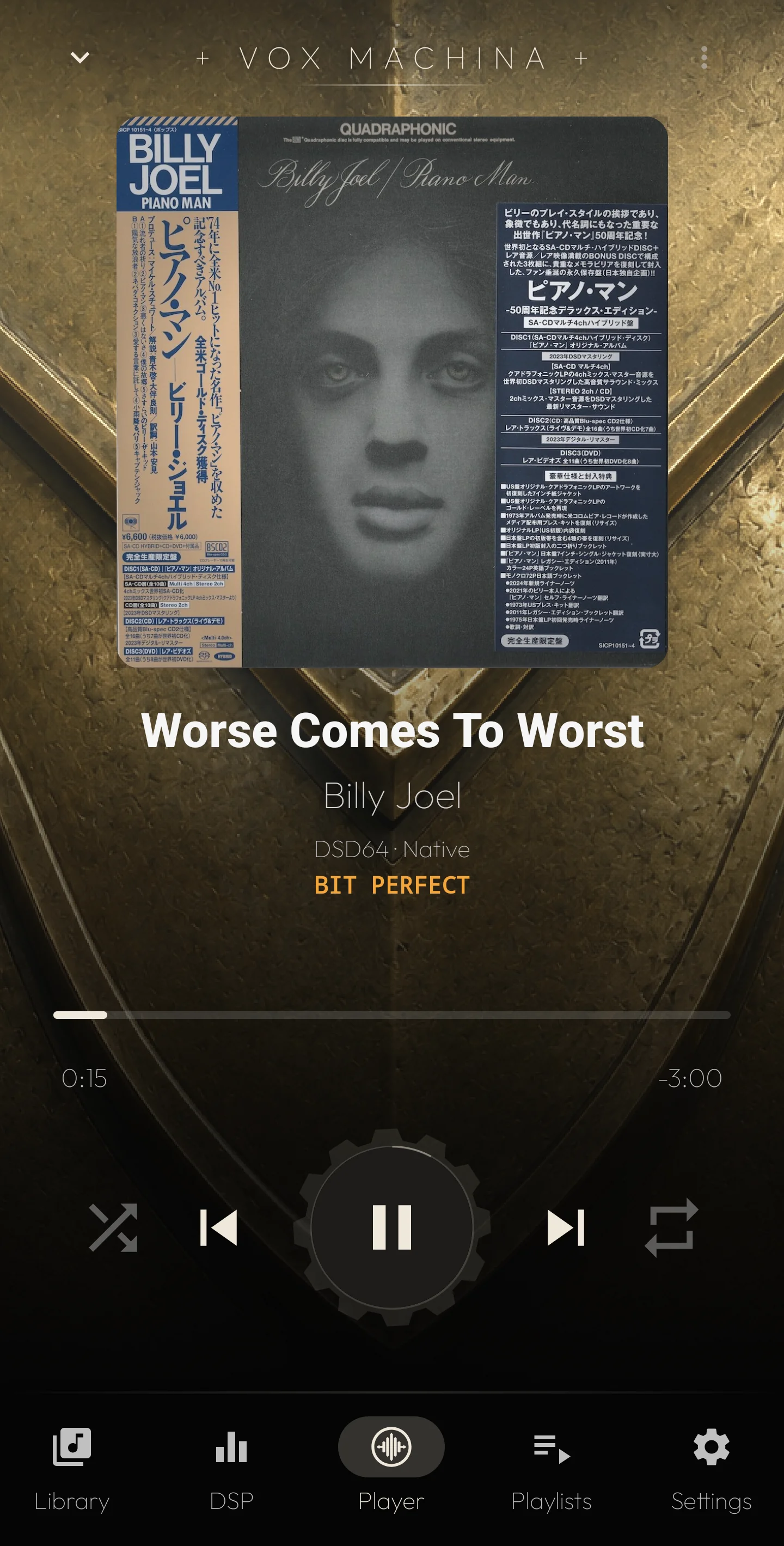
Vox Machina playing Billy Joel — Worse Comes To Worst — DSD64 Native, Bit Perfect

The Doctrine

Three policies govern the Engine's workings — what it plays, what it does not, and how it executes it. The listener selects, and the Engine answers:

I

Wide

Every track, on the wire.

The Engine selects the best available format for the connected DAC. Source rates and depths adapt as needed. Every transformation, declared; every transition, seamless.

II

Source Matching

Native rates above all.

When the DAC supports the source rate natively, the Engine prefers it — even over higher rates. The Engine seeks fidelity before convenience.

III

Bit Perfect

The signal, unaltered. The wire, intact.

Integer PCM delivered to the wire without float conversion, without DSP, without headroom adjustment. Native DSD up to DSD2048 via dedicated transport, if your DAC and device are sufficiently sanctified.


The Engine

Five named aspects of a single discipline. Each is declared below.

The Vox Machina library — 679 tracks across multiple formats

The Library

The Engine reads every file the same way it will play it — with the same decoder, the same witness. The library is not a separate accounting; it is the census of what the decoder can hear. Where other readers diverge on malformed containers or mislabeled headers, the Engine keeps one witness. The decoder is the census.

The Engine keeps two truths about each track:

  • The Gilded Census the truth of measure: sample rate, bit depth, format, duration.
  • The Gilded Lineage the truth of identity: title, artist, album.

Music comes in many forms, with as many tag standards — ID3, Vorbis, MP4 atoms, native FLAC, and the rest of the field's quiet sprawl. The Engine conducts its census across all of them and draws them into one coherent library — with unnatural speed. It surfaces complete catalogs where MediaStore returns fragments: DSD, WavPack, APE, AIFF, FLAC, WAV, Opus — alongside the companion files that make a true library whole: CUE, M3U, folder-level album artwork.

The Engine reads. The Engine does not write. It does not delete your files. It does not edit your tags. The library is the listener's jurisdiction, in all of its choices and its accidents.

No format left behind. No folder unreached. No companion lost. No name invented.

The Pipeline Card — integrity verified on a DSD64 stream

The Sealed Witness

Too long has the term “bit-perfect” been invoked — across pipelines no listener can witness, on definitions untested by proof. The Engine presents an end to this regime.

Bit-perfect is not merely declared. It is proven. The Sealed Witness computes CRC32 integrity checksums at two points in the pipeline — the moment a chunk leaves the decoder, and the moment the same chunk reaches USB submission. The two hashes are compared in real time. If they match, the signal has crossed the Engine untouched. If they diverge, the Engine names the cause.

Verification is per-chunk. Every block of audio is hashed before it enters the chain and hashed again at the wire. The Pipeline Card surfaces the verdict live: VERIFIED, ALTERED (an expected divergence under digital volume), MISMATCH (a fault), or UNVERIFIABLE. This sacred mechanism can be observed live — in both the Pipeline Card and the Advanced Diagnostics surface.

The Sealed Witness takes the stand only when Bit Perfect is engaged — an active sentinel of the golden path. Under the other policies, which admit transformation, quantization, and DSP, the Witness withholds judgment.

Every chunk witnessed. Every chunk declared. Every cause named.

Advanced Diagnostics — runtime engine truth, REGIME and TRANSPORT sections

The Passage

The Engine carries the signal to the wire itself. On Android, AudioFlinger does not see the audio path. A native worker at urgent-audio thread priority writes USB isochronous URBs directly to the connected USB DAC — a direct conduit from file to wire. Between decode and delivery sits a reservoir, a buffer that decouples decode timing from USB write and lets same-format track transitions cross with zero gap.

The Engine speaks every signal in its native tongue along that conduit. FLAC is decoded by a dedicated native bridge. DSF and DFF containers are parsed by dedicated forges — including DST-compressed streams and DSD-in-WavPack, both decoded natively and routed through the same pipeline without decimation. FFmpeg handles the rest: MP3, AAC, OGG, WAV, AIFF, ALAC, WavPack, APE, Opus.

Five pipeline domains carry what the decoder delivers: Float32 for processed audio, Integer Passthrough for bit-perfect PCM, DoP for DSD over PCM, DSD Native for raw one-bit, and a DSD→PCM decimator for sessions where DSP must be applied. The domain is chosen by doctrine, not by guess.

Every signal, its native tongue. Every byte, its own hand. Every track, its own doctrine.

The Iron Furnace resampler — four filter philosophies with frequency response

The Chambers

The chambers open at the listener's word. The Engine carries the signal through them, and declares every transformation along the way.

The equalizer offers thirty-one bands — parametric or graphic — with per-band bypass, direct gain entry, and an integrated AutoEQ library of thousands of measured headphone profiles. Automatic headroom attenuation prevents EQ boost from clipping the wire.

The convolver runs a partitioned overlap-save engine — for HRTF, room correction, or speaker correction. Crossfeed restores headphone imaging toward the speaker stage. Channel balance reaches per-channel precision. Apply Now drains the reservoir on demand so a setting change is heard immediately.

The Iron Furnace resampler (8,192-tap polyphase windowed-sinc, 95% passband preservation) engages only when the source rate does not match the DAC. When they match, the resampler does not exist in the chain. When they don't, the listener selects the filter philosophy: Mathematical (linear-phase Blackman-Harris), Minimum Phase (zero pre-ringing), Apodizing (relaxed passband, gentler high-frequency rolloff), or Brickwall (Kaiser β=14, >120 dB stopband). The cost is named, not hidden.

Every chamber, by the listener's word. Every transformation, declared. Every cost, named.

The Smart Playlists surface — the Engine watches as the listener listens, new rites unlock with time

The Auguries

The Engine keeps a spine of what the listener has played — the dates, the durations, the returns. From that spine, it composes shelves of further listening: not recommendations dispatched from a distant server, but offerings drawn from the listener's own habit. The Engine calls these the Auguries.

Some shelves surface the composers the listener returns to most. Some name the affinities the listener gathered, then forgot. Some wait until the listener has looked away long enough that the music returns as something half-familiar.

The signals are local. The arithmetic is the Engine's own. The mechanism is not advertised; the cards reveal themselves when the Engine deems the moment right, and no sooner. The listener finds them when the Engine offers them.

A sibling shelf draws not from history but from the wire itself: the Bit Perfect Playlist cross-references the listener's library against what the connected DAC can actually carry, admitting only the tracks that reach the wire unprocessed. The scan resolves swiftly and is remembered for each DAC; the next connection finds the playlist ready.

What the Engine reads, it reads from your device alone.

No fingerprint. No profile. No third party. No data leaves.


The Codex Machina

The Engine carries its own doctrine. A manuscript inside the app, naming and detailing every principle and every law behind every choice the Engine has made — and, more tellingly, every choice it has refused to make.

A listener never needs to read it.

The Codex waits for those who would understand.

Chambers Unseen

There are chambers the Engine does not advertise. A sanctum that remembers what the listener has done. The Cantor Obscura — the hidden singer — ready to reveal what the surface conceals. A queue that yields only to the listener who would summon it.

They open to those who would look.

The Engine has always preferred discovery to instruction.

Testament

The Forge does not boast; the Engine has its own voice, and it speaks for itself. Nevertheless, early listeners have spoken — and what they said is gathered here.

Vox Machina is no mere player-engine, but a machine-spirit forged for those devoted to the purity of sound. Crafted not for the masses, but for those whose ears awakened to finer truths. One can feel the care and labor poured into its creation through every detail. The Engine endures.

Play Store reviewer

The first music player app with worldbuilding and major creativity behind it. All other music players just play your music — Vox Machina has a story to tell. I have used all of the big music apps on Google Play and some of the lesser-known ones, and this is hands down my favorite player now.

Play Store reviewer

I have USB Audio Player Pro, Neutron Audio Player, NePlayer, Onkyo, and JRiver installed — bought all of them, and they're all great. But this one, via cable, blows them all away. Bit-perfect is especially something special. Nothing comes close to the sound from a phone.

Play Store reviewer

All my music files showing — 36,806 tracks. Scan and load time is way way faster than the only music player I use that can load more than 30k files.

ASR community

A new kind of bit-perfect. As compared to other paid bit-perfect apps, this sounds organic — not artificial like U, no added warmth and gain like N. Deserves a perfect score.

Play Store reviewer

Sound excellent, more similar to Onkyo HF Player than UAPP. Sound has proper dynamic heft — not lean, very open and 3D. Transparency is grain-free, so it doesn't mess with timbre.

Play Store reviewer

Lightly edited for clarity. Meaning preserved.


Get it on Google Play

Paid once. No subscription. No further toll.

Transmissions

To reach the Forge, to consult its covenants, and to read its Mark.